NFL Predictions: Why Opportunities Matter More Than Headlines
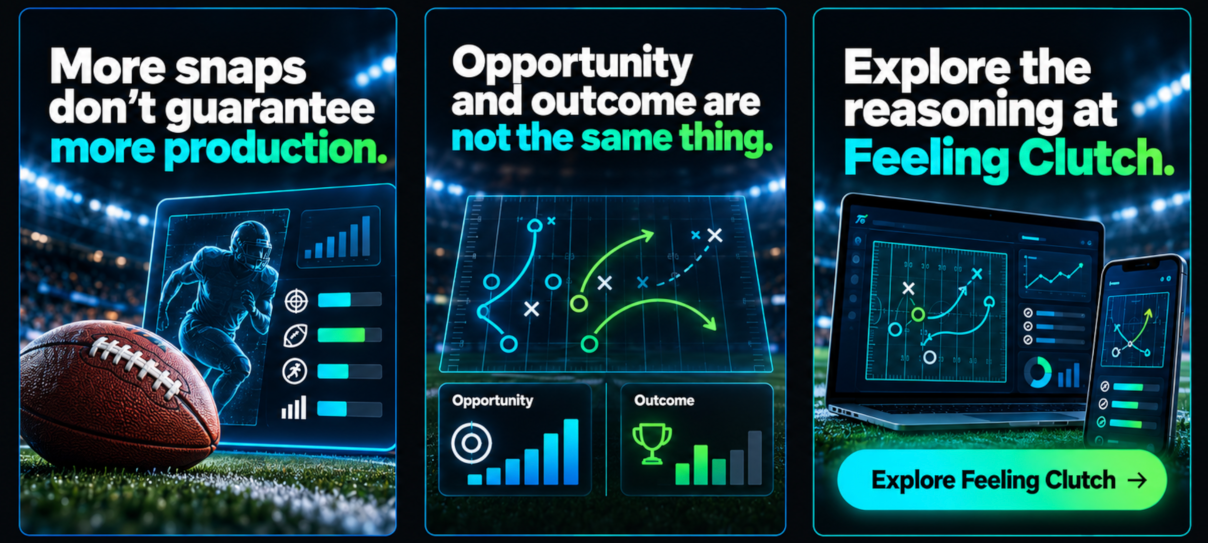
The scoreboard tells you what happened. The opportunities behind it help explain why.
Every NFL weekend brings a fresh wave of predictions.
One team is riding a winning streak. Another has struggled in recent weeks. Analysts debate momentum, star power, and which team has the advantage.
But what if the most important information isn't in the headline?
What if a team that scored 30 points last week actually played less efficiently than a team that scored 17?
And what if a team's recent winning streak hides weaknesses that could matter in its next matchup?
These are the questions that make data-driven NFL analysis more interesting.
At Feeling Clutch, we believe strong NFL predictions begin by understanding opportunities, efficiency, and matchup context—not simply choosing whichever team generated the most excitement last Sunday.
Because in football, creating opportunities is important. Turning them into results matters even more.
What Do Opportunities Mean in NFL Analytics?
An opportunity in football can mean several different things.
At the team level, analysts might examine offensive possessions, plays, scoring drives, red-zone trips, and field position.
These measurements help us understand how often an offense has chances to create meaningful results.
But there's an important distinction:
More opportunities don't automatically produce better performance.
A team can run many offensive plays without scoring efficiently.
Another team can produce touchdowns on fewer possessions.
That's why the number of opportunities should be evaluated alongside how effectively those opportunities are used.
A simple example
Consider two hypothetical NFL teams.
| Metric | Team A | Team B |
|---|---|---|
| Offensive drives | 12 | 10 |
| Total offensive plays | 72 | 60 |
| Offensive points | 21 | 28 |
| Points per drive | 1.75 | 2.80 |
Illustrative data only. These are not real NFL team statistics or Feeling Clutch predictions.
Team A had more drives and ran more plays.
Team B scored more points despite fewer opportunities.
Which offense performed more efficiently in this example?
Team B.
The lesson is straightforward.
Opportunity volume tells part of the story. Efficiency tells us what teams accomplished with those opportunities.
Neither measurement guarantees how a future game will unfold, but together they provide more information than total points alone.
Signal #1: Offensive Efficiency Matters More Than Raw Volume
One of the most useful ways to understand an NFL offense is to look beyond its total yardage.
A team might accumulate significant yards because it plays at a faster tempo, frequently trails opponents, or operates in games with many possessions.
Those circumstances can influence counting statistics without necessarily demonstrating stronger execution.
Efficiency metrics help provide context.
Yards per play
Yards per play measures the average amount of yardage gained on each offensive play.
It can help describe how effectively a team moves the football relative to its opportunities.
However, yards per play doesn't capture every important aspect of performance.
A team can accumulate yardage without finishing drives successfully.
Points per drive
Points per drive evaluates how effectively an offense converts possessions into scoring production.
This metric can be particularly informative when comparing teams that operate at different tempos.
An offense averaging more points per drive may be making better use of its possessions than an offense that simply runs more plays.
Early-down efficiency
Success on first and second down can influence the situations teams face later in a drive.
An offense that consistently gains meaningful yardage on early downs may encounter more manageable third downs.
That can help sustain possessions and improve opportunities to score.
When evaluating NFL predictions, these measurements become more informative when considered together.
The goal isn't to find the biggest number. It's to understand what the number actually measures.
Signal #2: Recent Performance Needs Context
Recent form often drives the conversation around NFL matchups.
A team wins three consecutive games, and suddenly it's described as unstoppable.
Another loses twice, and questions emerge about whether its season is falling apart.
But recent results can be misleading.
Not every winning streak tells the same story
Imagine Team A has won four consecutive games.
That sounds impressive.
But consider the circumstances.
Perhaps two wins came against opponents with significant injuries.
Another victory required multiple turnovers.
The fourth involved a late comeback against a struggling defense.
None of this means the wins weren't earned.
It simply means the circumstances surrounding those victories matter when evaluating future performance.
Similarly, a team that loses several close games against strong opponents might possess underlying strengths its record doesn't fully communicate.
What to examine in recent NFL performance
A more complete assessment considers the quality of opponents, offensive and defensive efficiency, turnover patterns, injuries, and consistency across games.
The goal is to distinguish meaningful performance trends from short-term fluctuations.
For example, a team that consistently creates scoring opportunities but struggles to convert them may have a different outlook from a team that rarely creates opportunities but has benefited from unusually favorable circumstances.
Neither situation guarantees improvement or decline.
They simply provide different information.
Recent results are evidence, but they aren't the entire explanation.
Signal #3: The Opponent Changes Everything
NFL teams don't play in isolation.
Their results depend partly on the strengths and weaknesses of their opponents.
An offense that thrives against one defensive style might struggle against another.
A defense that limits rushing production might face an opponent with a particularly effective passing attack.
That's why matchup context matters.
Offensive strengths vs. defensive strengths
Consider a hypothetical matchup between two teams.
Team A
- Strong passing efficiency
- Frequent explosive plays
- Moderate rushing efficiency
Team B
- Effective pass defense
- Strong pass pressure
- More vulnerable against the run
On paper, Team A has an impressive passing offense.
But Team B's defensive strengths could make that advantage more difficult to exploit.
The matchup creates questions that basic team rankings may not answer.
Can Team A maintain its offensive efficiency against this defense?
Will Team B's pass pressure influence the offense's approach?
Could Team A adjust its strategy to take advantage of other opportunities?
Understanding these interactions provides a more useful starting point than simply comparing each team's record.
NFL predictions should reflect how teams match up—not just how they rank.
Why More Possessions Don't Guarantee More Points
Offensive possessions are one of the clearest illustrations of why opportunity and efficiency must be considered together.
More possessions create additional opportunities to score.
But the outcome of each possession varies.
A drive can end in a touchdown, field goal, punt, turnover, or another result.
Field position can also influence how likely a drive is to produce points.
Consider a team beginning a possession near midfield compared with a team starting deep inside its own territory.
The two offenses may be equally capable, but the starting situations are different.
That is why points per drive, starting field position, and possession outcomes can add important context to an analysis.
A team that consistently creates favorable scoring opportunities may possess strengths that aren't obvious from total yardage alone.
At the same time, an unusually favorable field position advantage in one game may not repeat the following week.
Statistical analysis becomes more useful when it helps distinguish repeatable strengths from circumstances that may change.
The Role of Turnovers in NFL Predictions
Turnovers can dramatically alter football games.
An interception may end a promising drive.
A fumble can provide an opponent with favorable field position.
And a defensive touchdown can change the scoreboard without the opposing offense taking the field.
Because turnovers can have such a large impact, they're essential to understanding game results.
But their relationship with future performance requires care.
A team with several recent takeaways may be demonstrating effective defensive play.
It may also have benefited from opportunities that won't occur at the same frequency in future games.
Similarly, an offense suffering an unusually high number of turnovers may experience different outcomes as conditions change.
The key question isn't simply how many turnovers occurred.
It's whether the underlying performance supports expecting a similar pattern.
Past turnover results matter. But they shouldn't automatically be treated as a prediction of future turnovers.
Using Statistics to Evaluate NFL Win Probability
Once analysts understand opportunity volume, efficiency, recent performance, and matchup context, they can begin evaluating possible outcomes.
Statistical prediction models use measurable information to estimate the likelihood of different results.
For example, a hypothetical model might estimate:
| Outcome | Estimated probability |
|---|---|
| Team A wins | 61% |
| Team B wins | 39% |
Illustrative probabilities only. Not an actual NFL matchup forecast or verified Feeling Clutch model output.
Under this example, Team A would be the more likely winner.
But Team B would still have a meaningful chance of winning.
A properly calibrated model assigning a 39% probability to an outcome should see that outcome occur approximately 39% of the time across a sufficiently large group of comparable predictions.
This is why probability should never be confused with certainty.
A statistical advantage isn't a guarantee.
It represents an estimated difference in likelihood under a particular set of assumptions.
And those assumptions can change.
What Could Change an NFL Prediction?
Even well-supported pregame analysis has limitations.
Important developments can alter the expected matchup.
Injuries and roster availability
A team's recent performance may not accurately describe its current capabilities if important contributors are unavailable.
Weather conditions
Wind, rain, snow, and other weather conditions can influence offensive execution and game strategy.
Game script
An early lead can change how a team approaches its remaining possessions.
A team protecting a lead may choose different strategies from one attempting a comeback.
Coaching adjustments
Teams can modify their offensive and defensive approaches based on opponent tendencies.
Random variation
Unexpected events and unusual sequences can produce results that differ from statistical expectations.
No prediction model can account perfectly for every possibility.
That's why a thoughtful analysis should acknowledge where its assumptions might fail.
A Better Checklist for Evaluating NFL Games
Before evaluating an NFL matchup, consider five questions.
1. How many meaningful opportunities does each offense typically create?
Look at possessions, drives, and scoring opportunities rather than relying entirely on total yardage.
2. How efficiently does each team use those opportunities?
Consider points per drive, yards per play, and other relevant efficiency measurements.
3. What does recent performance reveal beyond the win-loss record?
Evaluate opponent strength, consistency, and relevant contextual factors.
4. How do offensive and defensive strengths interact?
A team's strongest statistical advantage may be less meaningful against an opponent particularly well equipped to challenge it.
5. What uncertainty remains?
Consider injuries, game conditions, strategic adjustments, and the possibility of unexpected results.
These questions won't reveal the future.
But they can help provide a more complete understanding of the matchup.
Why Prediction Doesn't Mean Certainty
It's easy to mistake strong evidence for certainty.
When several statistics point toward one team, the temptation is to describe the outcome as inevitable.
But that's not how probability works.
An NFL team can have advantages in offensive efficiency, defensive performance, and recent form and still lose.
One game is a single outcome from a range of possibilities.
A prediction can be reasonable based on the available information and still turn out to be incorrect.
What matters is whether the analysis was supported by sound reasoning and whether its uncertainty was communicated clearly.
Data-driven predictions should help us understand possibilities—not pretend that surprises are impossible.
Why Feeling Clutch Focuses on Data Over Hype
Sports predictions are often presented with dramatic confidence.
The biggest favorite.
The hottest team.
The can't-miss matchup.
But bold language isn't evidence.
At Feeling Clutch, our philosophy is built around a different approach.
Look at the data.
Understand the matchup.
Evaluate the relevant factors.
Recognize uncertainty.
The purpose of sports analysis isn't to make guarantees.
It's to help fans understand why one outcome may be more likely than another.
That means using evidence instead of unsupported claims.
It means explaining reasoning instead of relying on headlines.
And it means acknowledging that no prediction is certain.
No locks. No guarantees. Just data over hype.
Final Takeaway: Opportunities Tell a Bigger Story
NFL predictions become more informative when we look beyond the final score.
Opportunity volume helps describe how often teams have chances to produce results.
Efficiency helps explain what they accomplish with those chances.
Recent performance provides context about how teams have been playing.
And matchup analysis helps reveal why historical strengths may or may not translate into the next game.
None of these factors can guarantee a winner.
But together, they create a more complete picture of the matchup.
The next time you're evaluating an NFL game, don't stop at the standings or the latest headline.
Look at the opportunities.
Look at the efficiency.
Look at the opponent.
And remember that every prediction includes uncertainty.
Go Beyond the NFL Headlines
At Feeling Clutch, we believe better sports analysis starts with understanding the numbers behind the game.
Explore data-driven NFL predictions, examine matchup insights, and discover why the reasoning matters as much as the prediction itself.
Feeling Clutch — Data Over Hype.
Disclaimer: Sports predictions are probabilistic and outcomes are never guaranteed. Historical results, efficiency metrics, and statistical trends do not ensure future accuracy or betting profitability. This article is for educational and informational purposes.