NBA Predictions: The Stat Behind Tonight's Matchup
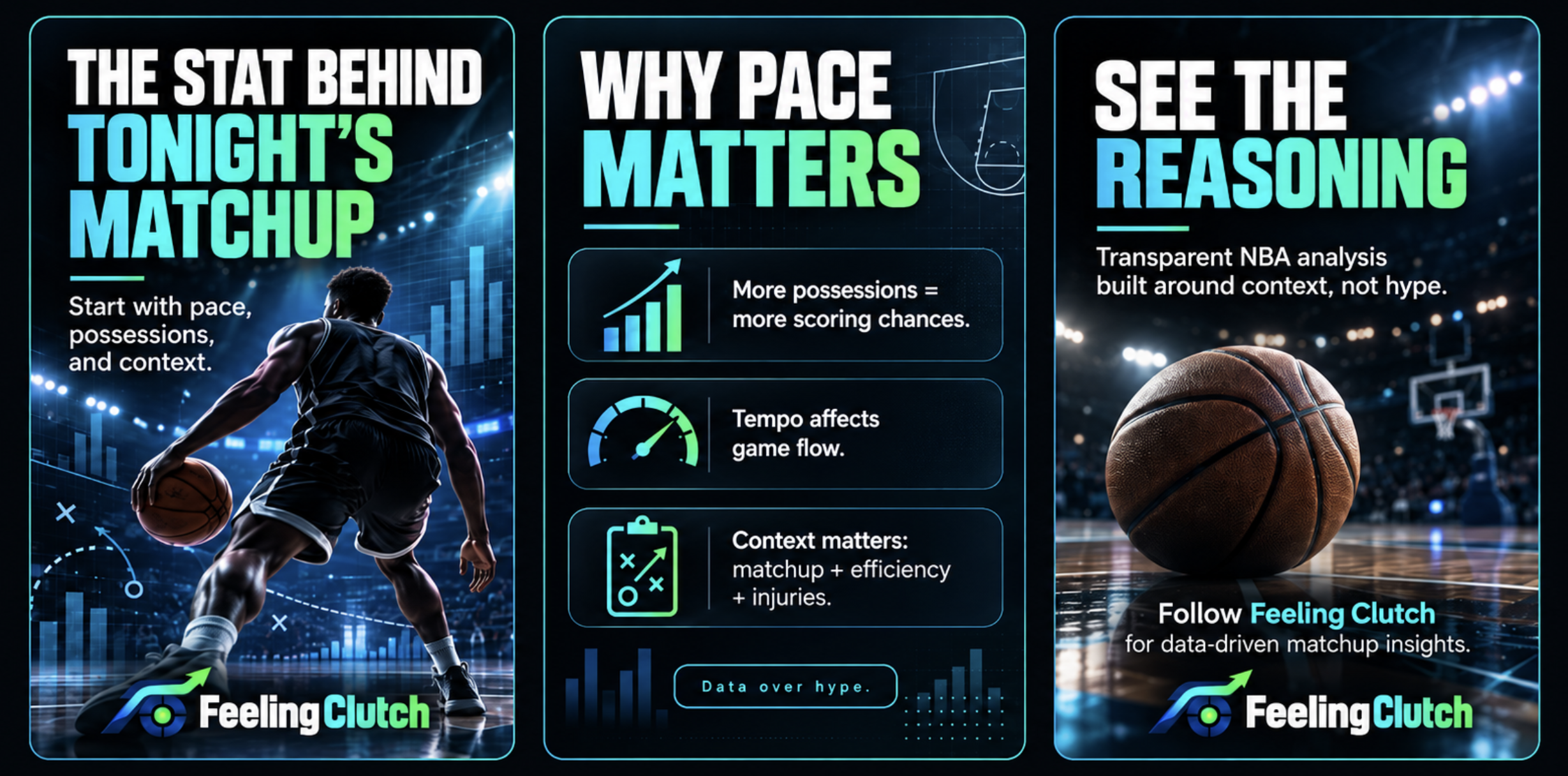
Why pace, possessions, and efficiency matter more than the headlines.
Every NBA game tells a story before the opening tip.
Fans look at star power. Analysts debate recent performances. Betting markets react to injuries, winning streaks, and public expectations.
But some of the most important clues about how a game might unfold are hidden in the numbers.
One of those numbers is pace.
Understanding pace—and how it interacts with possessions, offensive efficiency, and defensive performance—can help you evaluate NBA matchups with more context and less guesswork.
At Feeling Clutch, we believe better sports predictions start with better information.
Data over hype. Every time.
What Is Pace in Basketball?
Pace measures approximately how many possessions a team uses over a standard 48-minute NBA game.
It's a useful indicator of how quickly a team plays.
A fast-paced team generally creates more possession opportunities. A slower-paced team may favor longer offensive sets and more deliberate execution.
Why does that matter?
Because possessions create opportunities to score.
All else being equal, a game with more possessions has more opportunities for points than a game with fewer possessions.
But here's the important distinction:
More possessions don't automatically mean more points—or a better chance of winning.
The quality of those possessions matters just as much as the quantity.
Why Possessions Matter for NBA Game Predictions
Imagine two hypothetical matchups.
Matchup A: A fast-paced game
Both teams prefer pushing the tempo. They attempt to create quick scoring opportunities and regularly transition from defense to offense.
Matchup B: A slower-paced game
Both teams operate more deliberately, emphasizing half-court execution and controlled possessions.
Even before examining individual teams, these different playing styles can influence how we think about the game.
A higher-possession environment can create more opportunities for scoring.
A lower-possession environment can make each possession more consequential.
Neither approach guarantees a specific outcome.
The goal is to understand the conditions in which the game is likely to unfold.
Pace Alone Doesn't Tell the Whole Story
Here's where NBA predictions become more interesting.
Two teams can play at similar speeds and produce very different results.
That's because efficiency matters.
Offensive efficiency measures how effectively a team scores relative to its possessions. Defensive efficiency evaluates how effectively a team limits opponents' scoring on the same basis.
Consider this purely illustrative example:
| Metric | Team A | Team B |
|---|---|---|
| Pace | 102 possessions | 97 possessions |
| Offensive rating | 112 | 118 |
| Defensive rating | 110 | 108 |
Illustrative numbers, not actual NBA team statistics or Feeling Clutch model projections.
Team A plays faster, but Team B is more efficient offensively and defensively in this example.
Simply choosing the faster team would ignore important information.
A more informed evaluation asks:
- How many possessions might the matchup produce?
- How efficiently can each team score?
- How effectively can each team defend?
- How could contrasting playing styles affect the game's tempo?
- Have injuries or lineup changes altered recent performance?
These questions create a more complete picture of the matchup.
The Matchup Effect: When Styles Collide
NBA teams don't play in isolation.
Their performance depends partly on the opponent standing across the court.
A team that thrives in transition might encounter an opponent that excels at preventing fast-break opportunities.
A strong perimeter offense might face a defense specifically designed to limit three-point attempts.
And a team accustomed to playing quickly might have fewer possessions than usual against a deliberate opponent.
This is why evaluating season averages alone can miss important context.
The matchup matters—not just the individual team statistics.
A thoughtful prediction considers how two teams' tendencies interact, rather than assuming their historical averages will repeat.
Where Data-Driven NBA Predictions Fit In
Modern basketball analysis has access to an enormous amount of information.
Team performance, possession estimates, shot efficiency, defensive tendencies, recent form, home-court conditions, and injury reports can all contribute to an informed assessment.
Predictive models can help organize those inputs and estimate possible outcomes.
But models have limitations.
A model doesn't know the future. Its conclusions depend on the information available, the assumptions built into it, and how well it represents the matchup.
Even a team with a substantial estimated advantage can lose.
That's the difference between understanding probability and pretending to have certainty.
At Feeling Clutch, our philosophy is straightforward:
Good predictions should come with reasoning, context, and a clear acknowledgment of uncertainty.
Five Things to Check Before Tonight's NBA Games
Before evaluating an NBA matchup, consider five factors:
1. Pace: How quickly do these teams typically play, and how might their styles interact?
2. Offensive efficiency: Which team has been more effective at turning possessions into points?
3. Defensive efficiency: How well does each team limit scoring opportunities?
4. Recent context: Are injuries, lineup changes, scheduling, or recent performance affecting the matchup?
5. Uncertainty: Which assumptions could change before tipoff, and how sensitive is the analysis to those changes?
No single statistic should determine a game prediction.
Together, these factors provide a stronger foundation for understanding what might happen.
The Bottom Line: Data Over Hype
NBA predictions shouldn't begin and end with which team has the biggest star, the longest winning streak, or the loudest supporters.
The numbers tell a deeper story.
Pace helps explain the opportunities available.
Efficiency helps explain what teams do with those opportunities.
Matchup context helps explain why historical performance might change.
And thoughtful analysis helps put everything together.
No locks. No guarantees. Just a more informed way to understand the game.
See the Reasoning Behind the Game
Feeling Clutch is built around a simple idea: sports predictions should be supported by data, not hype.
Explore data-driven NBA matchup insights, understand the factors behind game predictions, and make your own informed decisions.
Feeling Clutch — Data Over Hype.
Sports predictions involve uncertainty. Past results and statistical trends do not guarantee future outcomes. This article is educational and does not constitute betting or financial advice.