AI Sports Predictions: What AI Can—and Cannot—Predict
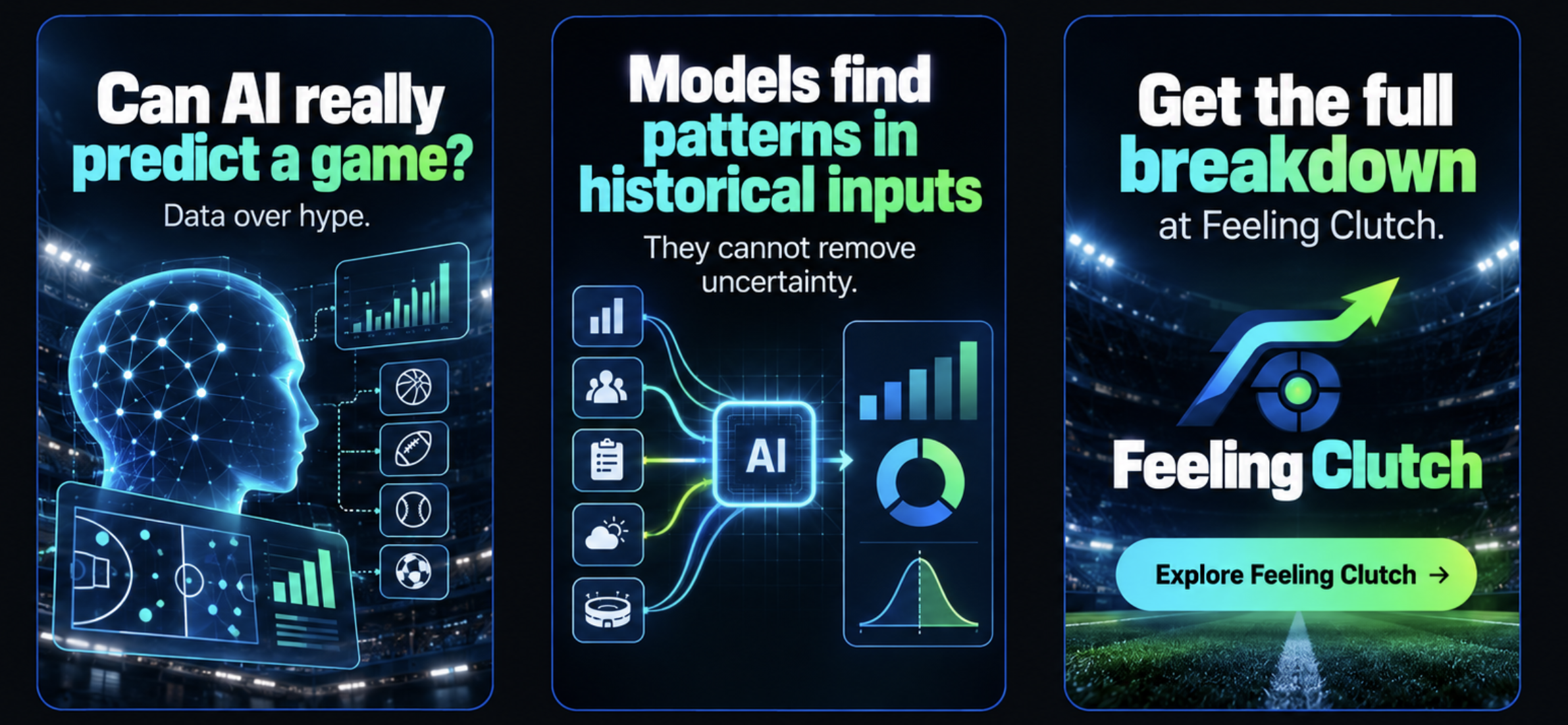
Artificial intelligence can analyze thousands of data points. But can it actually predict who wins the game?
Sports have always been unpredictable.
A last-second three-pointer. A fourth-quarter comeback. A missed field goal. A championship favorite losing to an underdog.
These moments are why we love sports—and why predicting outcomes is so difficult.
Today, artificial intelligence is changing how sports fans analyze games. Rather than relying exclusively on expert opinions, recent winning streaks, or gut feelings, AI sports predictions use statistical patterns and predictive models to estimate possible outcomes.
But there's an important distinction that often gets lost in the excitement surrounding AI.
AI can estimate what is likely to happen. It cannot guarantee what will happen.
At Feeling Clutch, we believe understanding that difference is essential to making sense of sports predictions.
Let's look at how AI-powered sports analysis works, what it can tell us, and where its limitations begin.
What Are AI Sports Predictions?
AI sports predictions use statistical algorithms, machine learning techniques, and historical data to estimate the probability of future sporting outcomes.
Instead of simply asking, "Which team looks better?", predictive analysis considers measurable factors that might influence the game.
Depending on the sport and the model, these factors can include:
- Historical team performance and recent form
- Offensive and defensive efficiency
- Home-field or home-court advantage
- Injuries, availability, and lineup changes
- Playing tempo and matchup characteristics
- Strength of schedule and opponent quality
- Relevant situational trends
By analyzing relationships between these variables, a predictive model can estimate the likelihood of different results.
For example, a model might estimate that Team A has a 65% probability of defeating Team B.
That doesn't mean Team A will win.
It means that, assuming the model is well calibrated, comparable situations assigned a 65% probability should result in the predicted outcome approximately 65% of the time.
The other 35% still matters.
Probability isn't a promise. It's a way of expressing uncertainty.
How Does AI Predict Sports Outcomes?
AI sports prediction systems generally follow a process involving data collection, analysis, modeling, and evaluation.
1. Collecting the right data
A model begins with information.
In basketball, relevant statistics might include pace, offensive efficiency, defensive efficiency, and possession-based performance.
In football, analysts might evaluate efficiency per play, turnovers, injuries, and defensive matchups.
In baseball, team-level analysis might include starting pitching, offensive production, bullpen performance, and ballpark conditions.
In soccer, models often incorporate team form, expected goals, defensive performance, and home advantage.
The precise inputs depend on the prediction being made.
More data isn't automatically better. Relevant, accurate, timely information matters more than simply collecting the largest possible dataset.
2. Identifying meaningful patterns
Machine learning algorithms attempt to identify relationships between historical inputs and outcomes.
For example, historical data might reveal how differences in offensive and defensive efficiency relate to game results.
A model can use patterns like these to evaluate future matchups.
However, identifying a statistical relationship does not automatically establish why it exists.
Models can also learn misleading patterns from historical data, particularly when the underlying dataset is small, incomplete, or unrepresentative.
That's one reason thoughtful model design is essential.
3. Estimating probabilities
The model uses its learned relationships and current inputs to produce an estimate.
The output might represent the probability of a home-team victory, an away-team victory, or another defined outcome.
Consider this hypothetical example:
| Possible outcome | Estimated probability |
|---|---|
| Team A wins | 62% |
| Team B wins | 38% |
Illustrative example only. These figures are not actual game predictions or verified Feeling Clutch model outputs.
These numbers describe a probability assessment—not a guaranteed result.
A team with a 38% chance of winning still has a meaningful opportunity to win.
Even if the model is accurate over many games, individual upsets should be expected.
4. Testing the model
A sports prediction model shouldn't be judged only by how convincing its predictions sound.
It should be evaluated using games that were not used to train it.
Useful evaluation methods include:
Calibration: When a model estimates a 70% chance of winning across many comparable predictions, does the predicted outcome happen approximately 70% of the time?
Prediction accuracy: How often does the model correctly identify the winning team?
Probability scoring: How well do the predicted probabilities reflect actual outcomes, including when the model is uncertain?
Performance over time: Does the model remain useful as teams, players, strategies, and conditions change?
Accuracy by itself can be misleading. Predicting the favorite in every game might produce a respectable win rate without providing especially informative probability estimates.
A reliable evaluation considers the quality of the predictions, not simply the number of correct winners.
What AI Can Predict in Sports
AI can help analyze patterns and estimate probabilities that would be difficult to evaluate consistently by intuition alone.
Team win probabilities
Statistical models can assess the relative likelihood of each team winning a matchup.
These estimates can incorporate differences in team strength, recent performance, location, and relevant context.
Matchup advantages
AI can help identify statistical differences between opponents.
A basketball team might have a strong offensive efficiency rating but face an opponent with unusually effective defensive performance.
Understanding that relationship provides a more complete picture than looking at either team independently.
Expected scoring environments
Models can estimate scoring conditions using relevant information.
In basketball, pace and efficiency can help explain expected scoring opportunities.
In football, offensive execution and defensive strength can affect scoring expectations.
In soccer, chance creation and defensive performance can help inform expected goal production.
These estimates remain uncertain because real games don't follow historical averages perfectly.
Changes in probability
Predictive assessments can change when new information becomes available.
An important injury update, a lineup change, or a significant change in team conditions might alter the assumptions behind an earlier prediction.
Good analysis should acknowledge when its inputs have changed.
What AI Cannot Predict Reliably
This is where responsible sports analysis separates itself from hype.
AI is powerful, but it has important limitations.
AI cannot guarantee a winner
No statistical model can eliminate the uncertainty inherent in sports.
A heavily favored team can lose.
A statistically weaker opponent can outperform expectations.
And a well-designed prediction can still be wrong.
Anyone describing an AI sports prediction as a guaranteed winner is misrepresenting what probability models can establish.
AI cannot anticipate every unexpected event
Models can incorporate historical injury patterns, estimated performance, and available team information.
They cannot know with certainty when an unexpected injury, controversial call, unusual coaching decision, or rare sequence of events will occur.
Some events are unpredictable even when the model is otherwise performing well.
AI cannot turn poor data into reliable predictions
The quality of the output depends heavily on the quality of the information provided.
Outdated injury information, incomplete statistics, inconsistent definitions, or incorrect assumptions can undermine a model's predictions.
Sophisticated algorithms don't automatically compensate for unreliable inputs.
AI cannot eliminate model uncertainty
Even strong models can disagree.
Different inputs, modeling techniques, or assumptions can produce different probability estimates for the same game.
Recognizing those differences is part of understanding predictive analysis.
AI cannot guarantee profitable betting
Estimating a sports outcome is not the same as identifying a profitable wager.
Betting prices, market margins, uncertainty, and the accuracy of probability estimates all matter.
Even a model that frequently predicts winners correctly does not necessarily identify favorable betting opportunities.
A predicted winner is not automatically a good bet.
Why Transparency Matters in AI Sports Predictions
Imagine two prediction tools analyzing the same matchup.
The first simply announces:
"Team A is a guaranteed winner."
The second explains that Team A appears stronger based on offensive efficiency, recent performance, and matchup conditions, while acknowledging the possibility of an upset.
Which analysis provides more useful information?
The second gives readers a foundation for understanding the prediction.
Transparent sports analysis should help answer three essential questions:
- What information supports this assessment? Readers should understand which factors are relevant.
- How uncertain is the outcome? Probabilities should reflect the possibility that an alternative result occurs.
- What could change the assessment? Injuries, lineup changes, and unexpected circumstances can affect the outlook.
Transparency doesn't make a prediction infallible.
It makes the reasoning easier to evaluate.
That's an important part of the Feeling Clutch philosophy.
Data over hype. Reasoning over guarantees.
AI Sports Predictions vs. Traditional Expert Picks
Traditional sports analysis often relies on an analyst's understanding of teams, strategy, experience, and situational context.
AI-based analysis attempts to evaluate statistical information more systematically.
Both approaches have strengths and limitations.
| Traditional expert analysis | AI-based prediction analysis |
|---|---|
| Emphasizes qualitative interpretation | Emphasizes patterns in structured data |
| Can incorporate tactical observations | Can consistently evaluate many variables |
| May be influenced by personal bias | May reflect bias in training data or assumptions |
| Often communicates narratives | Can estimate explicit probabilities |
| Depends on analyst judgment | Depends on model design and data quality |
These methods aren't necessarily opposites.
Human judgment can help assess whether model assumptions are reasonable and whether relevant information is missing.
Statistical models can challenge intuition by revealing patterns that aren't immediately obvious.
The most useful approach focuses on evidence, sound assumptions, and appropriate uncertainty—not whether a prediction came from a person or an algorithm.
How to Evaluate an AI Sports Prediction Tool
Before trusting any AI-powered sports prediction platform, look beyond its marketing claims.
Start by asking whether the platform explains how it approaches game analysis.
Does it distinguish between model estimates and verified results?
Does it explain uncertainty?
Does it provide meaningful context instead of simply announcing winners?
Are any advertised performance statistics supported by verifiable records and clearly defined evaluation methods?
And perhaps most importantly, does it acknowledge that every prediction can be wrong?
A flashy prediction alone offers little insight into its reliability.
The reasoning behind a prediction matters just as much as the prediction itself.
The Future of AI in Sports Analysis
AI has the potential to make sophisticated sports analytics more accessible.
Improvements in data collection, statistical modeling, and analytical tools can help fans explore matchups with greater depth.
But the future of sports predictions shouldn't be about replacing uncertainty with exaggerated confidence.
It should be about understanding uncertainty more clearly.
Technology can help us analyze more information.
It can help us identify relationships and challenge assumptions.
It can help us ask better questions about why one outcome may be more likely than another.
What it cannot do is remove the unpredictability that makes sports compelling.
And that's okay.
Final Takeaway: Better Predictions Start With Better Questions
AI sports predictions aren't magic.
They're statistical assessments built from data, algorithms, assumptions, and uncertainty.
They can estimate probabilities, highlight matchup factors, and provide a structured way to evaluate games.
But they cannot guarantee winners, anticipate every unexpected event, or promise profitable betting outcomes.
The goal isn't to pretend we know exactly what happens next.
It's to understand the available information before the game begins.
That's the philosophy behind Feeling Clutch.
Go Beyond the Prediction
At Feeling Clutch, we believe sports analysis should be driven by evidence, thoughtful reasoning, and an honest understanding of uncertainty.
Explore data-driven sports predictions and discover the factors that matter beyond the headlines.
Feeling Clutch. Data Over Hype.
Disclaimer: Sports predictions are probabilistic and never guaranteed. This article is for educational purposes and does not constitute betting or financial advice.